To optimise the efficiency of the takeoff in long jump, I generally cue the athlete to hold the knee blocked at around 90 degrees or just under, with the opposite arm simultaneously punched to roughly shoulder height and blocked, deliberately before going into any in air motions.
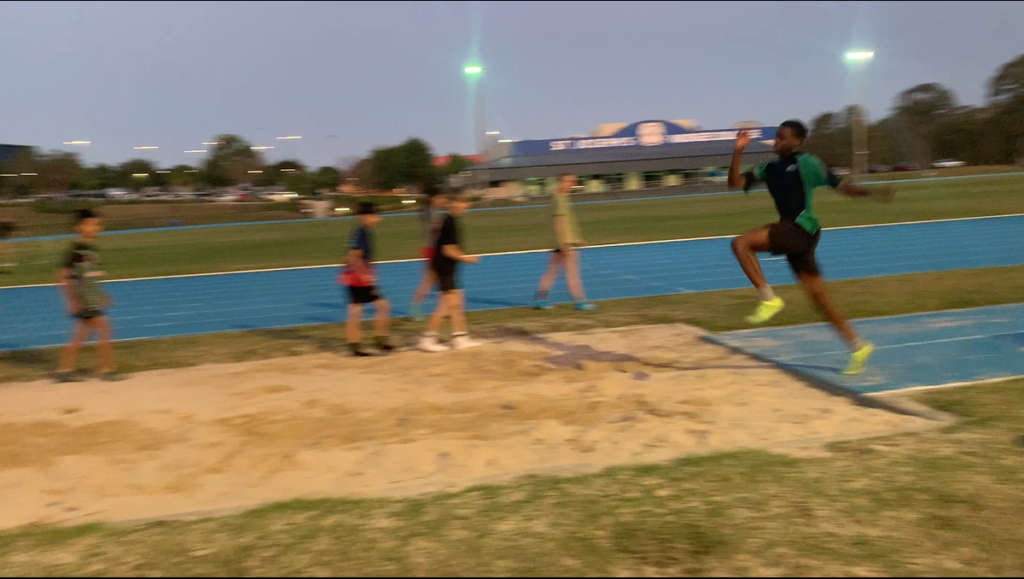
This is the position that we want, the knee is at 90%, ankle is fully extended and the arm can block at around shoulder height
I find that this has 2 main benefits- achieving full triple extension especially at the ankle and knee joint, ensures that the calves and quads violently contribute to generating lift, which allows the athlete to get height in their jump without compromising their horizontal speed as much (which is extremely beneficial since the majority of the jump distance, assuming an average take-off and landing, comes from the horizontal velocity component). It doesn’t require much ‘preparation’ or rhythm change to extend these joints. Simon Ehammer, the Swiss decathlete/long jumper is a good technical model to look at for this and I have seen other people praise his technique on Instagram. He is able to retain his sprint speed quite well with virtually no ‘preparation’ rhythm change and creates a ton of lift with knee extension and a completed triple extension of the ankle, knee and hip.
The other benefit is that holding the takeoff delays the in-air motions longer, so that by the time the athlete reaches their in-air position with the arms up, and then subsequently their leg shoot, they initiate their leg shoot later, which means there is less time for their over rotation to take effect and tip them down. Executing all of these items perfectly in sequence isn’t a requirement for an awesome jump, but it does seem to help consistency of both the takeoff and the landing.
The simplest technique I will start most athletes on, consists of a takeoff drive, which is ideally held for a reasonable amount of time before transitioning into both arms above the head, which is then also held to counteract forward rotation (an elongated position is harder to rotate forward than a crunched one), and this keeps the head and chest up as well, enabling them to hold their legs higher. If they are a fast athlete capable of running more than 10m/s, adding the hitch kick can help further avoid the forward rotation that comes from running at this speed.
Some athletes like to retract their legs and arms behind them in the air to prepare for a big leg shoot, (I’ve seen this from beginner kids, even up to some fairly high level high schoolers) but I observe they often enter this position too early having not held a takeoff, and it also induces the legs to kind of tip down or be less extended with the knees bent, because it’s hard to maneuver the legs from behind the body back to the front of the body, and it’s also harder to shoot the legs out if they are a bit straighter swinging under the body, compared to a leg shoot coming from the arms and knees up position. I usually try to change this aspect of the athlete’s technique as I’ve observed it usually inhibits their jump in a number of ways.
Leave a Reply